Remote control vehicles are no longer limited to weekend recreation. In classrooms, they can become moving laboratories for science, technology, engineering, and mathematics. Students can steer a small rover across a taped route, measure stopping distance, or adjust wheel speed on different surfaces. These activities make abstract ideas visible. They also invite teamwork, testing, and repair.
The World Economic Forum’s Future of Jobs Report 2023 found that 44% of workers’ skills may be disrupted within five years. It also identified analytical thinking as a leading core skill. This context explains how can remote control vehicles be used for educational purposes. Learners can practice coding, basic electronics, geometry, data collection, and problem-solving through one physical project. Seymour Papert, a pioneer of constructionist learning, wrote, “The role of the teacher is to create the conditions for invention rather than provide ready-made knowledge.” A classroom vehicle supports that approach. Students invent, fail, revise, and try again.
The results are not automatically impressive. A vehicle can become expensive entertainment without clear learning goals. UNESCO’s Global Education Monitoring Report 2023 also cautions that technology does not guarantee better learning. Teachers must connect each driving task with measurable outcomes. For example, students might record ten trials, compare turning angles, and explain inconsistent results. Small evidence matters. Accessibility also requires attention, since not every learner can use standard controllers comfortably. This article examines practical classroom uses, suitable age groups, safety considerations, and assessment methods. It also questions whether every remote control activity deserves classroom time. Sometimes, a simpler cardboard prototype teaches more.
What Are Remote Control Vehicles in Education?
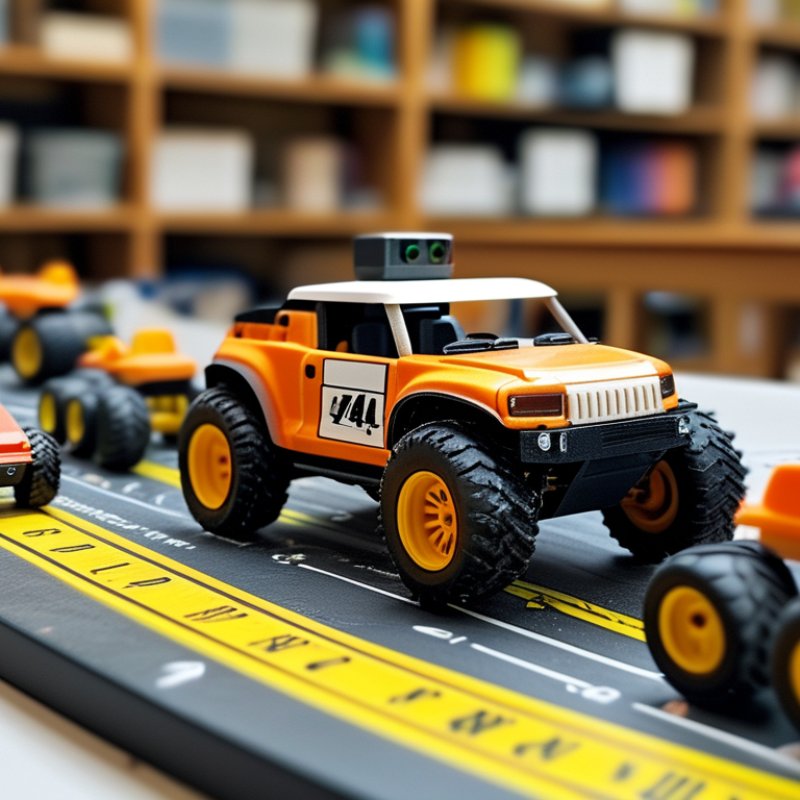
Remote control vehicles in education are small, programmable machines operated through a wireless controller. They may use wheels, tracks, motors, sensors, batteries, and simple steering systems. In a classroom, students can measure speed, calculate turning angles, or program a vehicle to follow a marked path. A six-meter tape track can become a practical lesson in distance, time, friction, and error.
These vehicles connect physical movement with digital thinking. The World Economic Forum’s Future of Jobs Report 2023 identified analytical thinking as the most important core skill, cited by 69% of surveyed employers. Students can practise that skill when a vehicle misses a corner and they adjust its code.
Small failures become visible. Sometimes, it is only a loose wire. That matters.
Remote control vehicles also support teamwork, design, and problem-solving. One student may test the motor, while another records battery performance or checks measurements. However, the UNESCO Global Education Monitoring Report 2023 warns that technology does not automatically improve learning; results depend on teaching quality, access, and context. A vehicle can become an expensive toy if activities lack clear learning goals. Teachers should provide safe spaces, simple instructions, and time for reflection. Even then, some students may focus more on speed than understanding, which deserves honest review.
How Are Remote Control Vehicles Used in Classroom Activities?
In classrooms, remote control vehicles turn abstract ideas into visible movement. Students can test speed, friction, distance, and battery use on a taped floor. A simple challenge works well. Move a vehicle through a paper maze without touching the walls. Teams measure three attempts, record errors, and explain changes. This gives teachers observable evidence of reasoning, not just completed worksheets.
The Education Endowment Foundation reports that collaborative learning can produce about five months of additional progress, on average. A vehicle task supports this when roles rotate: driver, timer, recorder, and safety checker. Students must negotiate commands and defend their measurements. The World Economic Forum’s Future of Jobs Report 2023 identified analytical thinking as the most valued core skill among employers. This activity practices analytical thinking through practical constraints. Teachers should connect every movement to a question. Why did the vehicle veer left? Was the turn too sharp? The answers can lead to graphs, ratios, and revised designs.
However, the method is not flawless. OECD PISA 2022 reported that about 30% of students saw digital-device distraction in most or every mathematics lesson. Noise and competition may create another distraction. Use low speeds, marked lanes, and short trials. Not every learner enjoys controlling a vehicle. Some may prefer mapping, writing instructions, or analyzing data. I would assess the explanation, not the fastest lap. A slow vehicle can still reveal a flawed hypothesis.
How Can Remote Control Vehicles Be Used for Education?
Remote control vehicles help students investigate motion, measurement, coding, forces, friction, and engineering design. In a ten-second classroom test, distance is calculated using the formula distance = speed × time.
Students can measure time and distance, compare predicted and observed results, program speed or direction changes, and discuss how surface friction affects vehicle movement. The values shown are calculated from four constant speeds over a ten-second test.
Conclusion
Remote control vehicles can transform abstract lessons into engaging, hands-on learning experiences. In education, they are small programmable or manually operated vehicles that allow students to explore movement, distance, speed, direction, and basic engineering concepts. To understand how can remote control vehicles be used for educational purposes, teachers can connect them with mathematics, science, technology, and problem-solving activities. Students may calculate travel time, measure routes, study friction, or adjust controls to improve performance.
In classroom activities, learners can design obstacle courses, complete navigation challenges, and work in teams to guide vehicles through planned routes. They can also build simple models, investigate energy use, create coding instructions, or develop projects focused on transportation and environmental efficiency. These tasks encourage creativity, communication, logical thinking, and persistence. Teachers can assess learning through project plans, measurement records, teamwork, explanations, and final demonstrations, evaluating both the completed vehicle task and the students’ ability to reflect on mistakes, apply evidence, and suggest improvements.
 HSED Toys

