 HSED Toys
HSED Toys
HSED Toys
How do remote control vehicles support engineering learning? The answer begins with a practical classroom problem: students need to connect equations with physical results. A small rover makes that connection visible. Learners measure wheel diameter, calculate gear ratios, adjust motor speed, and watch the vehicle respond across tile, carpet, or loose soil. They also confront friction, battery limits, sensor noise, and imperfect assembly. That experience is difficult to reproduce through diagrams alone.
The World Economic Forum’s Future of Jobs Report 2023 identified analytical thinking as the most sought-after core skill, cited by 69% of surveyed employers. Remote control projects develop this skill through repeated testing. Students form a hypothesis, collect data, revise code, and explain unexpected movement. The process resembles real engineering work. ABET’s engineering accreditation criteria also emphasize design, experimentation, teamwork, communication, and consideration of safety and environmental constraints. A vehicle project can bring these outcomes together in one manageable system.
Small failures matter.
A robot that turns too sharply can reveal incorrect calculations. A weak battery can expose poor power planning. These moments build engineering judgment, although they can also frustrate beginners. Educators must provide structured worksheets, safe operating areas, and clear assessment criteria. The IEEE Engineering in Training and Education community has repeatedly highlighted hands-on, project-based learning as a way to strengthen technical understanding and professional skills. Still, remote control vehicles are not a complete engineering curriculum. Their value depends on thoughtful questions, reliable measurements, and reflection after testing. The strongest lessons ask not only whether the vehicle moved, but why it moved that way.
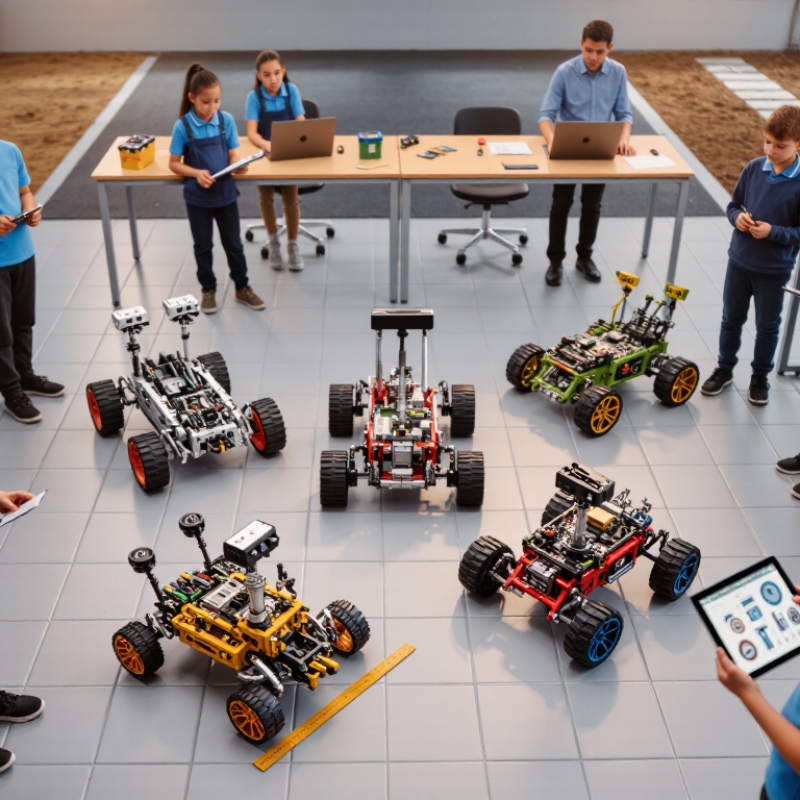
Remote-controlled vehicles turn abstract engineering into visible cause and effect. A steering command travels through a 2.4 GHz radio link, reaches a receiver, and moves a servo. This band sits within the widely used ISM range, but it is not one universal communication protocol. Systems may use different channel access, hopping, coding, and failsafe methods. Students can measure response delay, signal loss, and battery voltage during track tests. They learn that reliable control depends on antennas, power budgets, firmware, and physical surroundings.
In a classroom project, learners can map performance beside walls, metal frames, and other wireless devices. The results make interference less mysterious. A vehicle may react smoothly at ten meters, then hesitate behind an obstacle. That failure is useful evidence. Engineers can compare frequency-hopping behavior, receiver sensitivity, and packet-loss recovery while documenting test conditions. They should also separate control traffic from telemetry. Mixing both without planning can increase delay. Practical judgment matters more than impressive specifications.
Tips: Keep the vehicle slow during tests. Check failsafe behavior before every run. Record distance, obstacles, voltage, and observed latency. Use legal regional settings for radio equipment. Do not treat 2.4 GHz as interference-proof. It is common, not magic. A common mistake is underestimating antenna placement. A carbon panel or metal bracket can weaken the link unexpectedly. Students should question clean results and repeat measurements.
It makes abstract ideas visible through movement, speed, turning, and energy use. Students can test theories on a real floor.
The motor, drivetrain, steering, battery, wiring, and control system create different testing opportunities. Each subsystem produces measurable behavior.
They can observe how alignment affects direction and stability. A slightly misaligned wheel may pull the vehicle across the floor.
They can measure wheel speed, estimate torque, compare gear ratios, and record travel time. The numbers may disagree sometimes.
Students compare symptoms with evidence, such as voltage drops or uneven movement. They repeat tests instead of trusting one result.
They can create wiring diagrams, write test reports, and explain design choices. Short design reviews encourage clear technical speaking.
Students can divide testing, documentation, construction, and data analysis. Respectful disagreement is useful, but teams may still miss important details.
They should consider overheating, safe testing areas, accurate data, and responsible material use. Exciting crashes should not replace careful testing.
They rehearse troubleshooting, measurement, documentation, collaboration, and design revision. These habits appear in many engineering workplaces.
A small vehicle cannot represent every engineering role or outcome. A fast vehicle may reward speed over safety and accessibility.
Remote-controlled vehicles provide a practical way to connect engineering theory with hands-on problem solving. Students can examine how a 2.4 GHz communication standard supports reliable command transmission, then relate vehicle subsystems—including power, control, communication, sensing, and mechanical structures—to seven broad engineering student outcomes. By building and operating these systems, learners develop abilities in design, teamwork, experimentation, technical communication, and ethical decision-making. In this context, how do remote control vehicles support engineering learning? They turn abstract concepts into observable results and encourage students to improve designs through testing.
A key example is pulse-width modulation (PWM), which allows steering servos to respond to control signals commonly spaced within a 10–20 millisecond timing range. Students can measure these signals, adjust parameters, and evaluate accuracy and stability. They can also study the testing challenges of a planetary rover equipped with 23 cameras, using its complex sensing system as inspiration for planning, verification, and troubleshooting. These experiences build skills relevant to engineering careers, especially as employment across engineering occupations is projected to grow by 4 percent.

