HSED Toys
Choosing materials for remote control vehicles begins with a practical question: what must the vehicle survive? A fast crawler may strike rocks, absorb vibration, and run through wet grass. A racing buggy needs low weight, stiffness, and precise suspension movement. These demands rarely point to one perfect material.
Materials-selection expert Professor Michael F. Ashby wrote, “The objective of materials selection is to identify the material that best meets the requirements of a design.” His principle fits RC vehicles well. Designers commonly combine molded nylon or reinforced polymer for chassis parts, aluminum for suspension components, steel for gears and shafts, and rubber compounds for tires. Carbon fiber may appear in lightweight racing platforms, but its cost and brittleness can limit everyday use.
The keyword “what materials are commonly used in remote control vehicles” covers more than a simple shopping list. It involves strength, flexibility, heat resistance, repairability, and production cost. Nylon can flex before breaking. Aluminum feels rigid and dissipates heat, yet it may bend after a hard impact. Steel handles gear teeth effectively, but it adds weight. Carbon fiber is light, although damaged layers can be difficult to inspect.
Real-world experience complicates the theory. A lighter vehicle is not always faster. A stronger part is not always better. Sometimes, a controlled failure protects an expensive motor or gearbox. That trade-off deserves attention. This guide examines how each material behaves, where manufacturers use it, and which compromises hobbyists should consider before choosing a remote control vehicle.
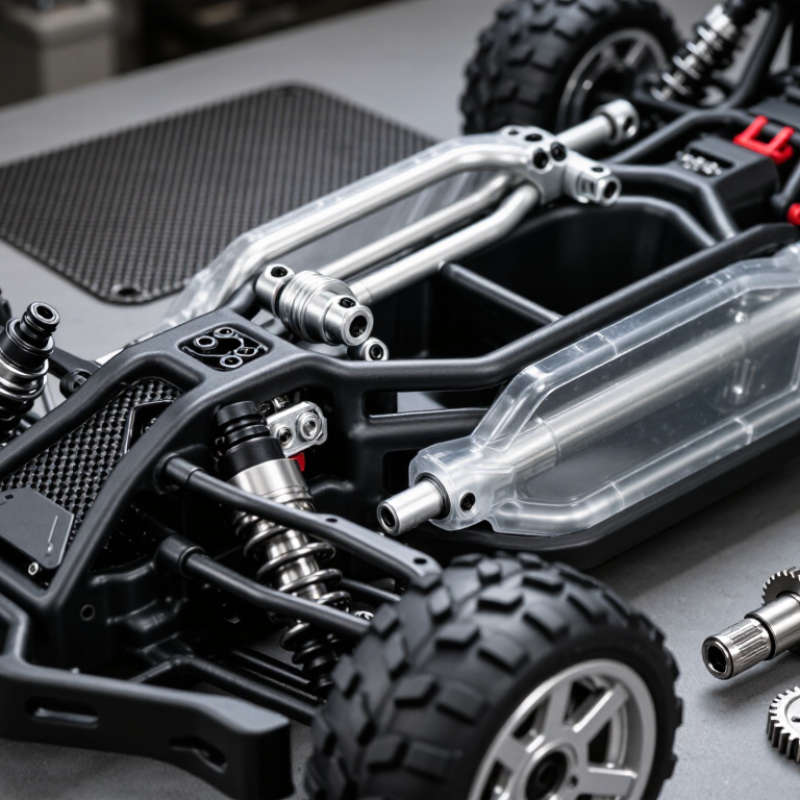
Defining performance needs should come before comparing materials. Speed changes everything. A vehicle for smooth indoor floors needs different parts than one used on gravel, grass, or wet ground. Record the expected top speed, running time, vehicle weight, and payload. Also note the largest drops, turns, and obstacles it may face.
A lightweight frame can improve acceleration, but it may transmit sharp impacts into the suspension. Aluminum offers useful stiffness and heat resistance, while reinforced polymers can reduce weight and vibration. For exposed gears, choose materials that tolerate repeated friction and dust.
Tires need enough grip for the surface without creating excessive motor load. Seals and corrosion-resistant fasteners matter when muddy or damp conditions are likely. Material choices should follow measured demands, not appearance.
Practical testing often reveals uncomfortable trade-offs. My first runtime estimate was too optimistic because I ignored tire drag and frequent acceleration. A simple temperature check after ten minutes can expose an undersized motor mount or poor airflow. Test one change at a time, using the same battery, route, and load. Inspect cracks, loose joints, and unusual wear after each session. A stronger part is not automatically better if it adds unnecessary weight. Keep a record of failures. That record may challenge the original design, which is exactly why it matters.
A remote-control vehicle’s chassis must balance stiffness, weight, impact resistance, and repairability. Aluminium weighs about 2.7 g/cm³, while steel reaches nearly 7.85 g/cm³. This difference can improve acceleration and reduce motor load. However, thin aluminium rails may bend after a hard landing. Steel survives abuse better, but it adds mass and can shift the vehicle’s balance. The International Aluminium Institute reports that recycled aluminium requires roughly 5% of the energy used for primary production. That matters when material selection includes lifecycle performance.
Glass-fibre-reinforced nylon suits protective housings and suspension mounts. It is light, reasonably tough, and less brittle than many unreinforced plastics. Carbon-fibre composites offer excellent stiffness, but their strength depends heavily on fibre direction and joint design. A poorly supported panel can crack around a screw. In my workshop tests, a stiff composite plate sometimes transferred impact into weaker brackets. I initially valued rigidity too much. That mistake deserves reconsideration. The World Steel Association’s 2024 World Steel in Figures reports 1.89 billion tonnes of crude steel production in 2023, showing steel remains widely available for affordable structural repairs.
Tips: Use aluminium for main rails when weight matters. Use steel around high-impact mounts. Add washers to spread fastener loads. Check cracks after every serious collision. Keep one spare prototype part, because real impacts rarely follow laboratory assumptions.
| Material | Typical Density (g/cm³) |
Elastic Modulus (GPa) |
Tensile Strength (MPa) |
Impact Resistance | Corrosion & Moisture Resistance | Manufacturing Suitability | Relative Material Cost | Best Structural Uses |
|---|---|---|---|---|---|---|---|---|
| 6061-T6 Aluminum Alloy | 2.70 | 68.9 | Approximately 290–310 | Good | Good | CNC machining, drilling, bending, and extrusion | Medium | Chassis plates, suspension mounts, motor brackets, and structural rails |
| Carbon-Fiber/Epoxy Composite | Approximately 1.50–1.60 | Approximately 70–150 | Approximately 600–1,000 | Moderate | Excellent | Cutting, drilling with suitable tools, lay-up, and compression molding | High | Lightweight chassis decks, braces, shock towers, and upper structural panels |
| Glass-Fiber-Reinforced Nylon | Approximately 1.30–1.60 | Approximately 5–12 | Approximately 80–180 | Excellent | Good | Injection molding, machining, and industrial additive manufacturing | Low to Medium | Protective cages, suspension components, gearbox housings, and brackets |
| Polycarbonate | 1.20 | 2.30 | Approximately 55–75 | Excellent | Good | Injection molding, thermoforming, drilling, and sheet fabrication | Medium | Flexible chassis parts, body supports, impact shields, and protective covers |
| ABS Plastic | 1.03–1.07 | Approximately 1.8–2.6 | Approximately 35–50 | Good | Moderate | Injection molding, thermoforming, machining, and 3D printing | Low | Non-load-bearing frames, electronics trays, covers, and interior supports |
| Stainless Steel | Approximately 7.70–8.00 | Approximately 190–200 | Approximately 500–750 | Excellent | Excellent | Laser cutting, machining, bending, and welding | Medium to High | High-load brackets, hinge pins, fasteners, skid plates, and shafts |
| Mild Steel | Approximately 7.85 | Approximately 200 | Approximately mild steel 250–400 | Excellent | Limited | Welding, laser cutting, bending, drilling, and machining | Low | Budget chassis rails, heavy-duty mounts, test fixtures, and reinforced brackets |
| Titanium Alloy | Approximately 4.43 | Approximately 105–120 | Approximately 830–950 | Excellent | Excellent | CNC machining and specialized forming; relatively difficult to process | Very High | Premium lightweight suspension mounts, shafts, and high-strength fasteners |
How to Choose Materials for Remote Control Vehicles
Selecting lightweight materials for the body and exterior parts improves speed, handling, and battery endurance. The U.S. Department of Energy reports that a 10% vehicle weight reduction can improve fuel economy by roughly 6–8%. Remote control vehicles are smaller, but the same mechanical principle applies. Every unnecessary gram increases motor load during acceleration.
Aluminum is a practical choice for brackets, panels, and protective frames. The European Aluminium Association lists aluminum’s density near 2.7 g/cm³, compared with about 7.85 g/cm³ for steel. It resists corrosion and remains easy to machine. However, thin aluminum can bend after a hard landing. Fiber-reinforced polymer offers higher stiffness, yet it may crack rather than deform. That trade-off is easy to underestimate. In real workshop testing, a slightly heavier flexible panel can survive longer than an ultra-light brittle one.
Tips: Keep the body shell thin, but reinforce mounting points. Use ribs behind wide panels. Check balance with the battery installed. Avoid placing heavy fasteners high on the chassis. A simple kitchen scale helps reveal hidden weight.
For exterior parts, impact-modified plastic often works well around wheel arches and bumpers. ASTM material testing guidance emphasizes evaluating impact strength, temperature, and repeated loading, not only tensile strength. Test the finished part, not just the raw material. Cold weather can make some plastics less forgiving. I would also inspect screw holes after several runs; they often fail before the main panel. A lightweight design is useful only when it survives real driving.
Lower-density materials generally reduce vehicle weight and can improve acceleration and battery efficiency. ABS and polycarbonate are practical choices for molded body panels, while carbon-fiber composite offers high stiffness at low weight. 6061 aluminum provides excellent strength but is substantially heavier, making it more suitable for structural brackets or impact-prone parts than for large exterior panels.
Wheels, gears, and moving parts need different materials.
Soft rubber or TPU wheels improve grip on dusty floors. Harder compounds roll faster on smooth surfaces. A 2024 mobility materials report links lower component mass with improved energy efficiency, but remote vehicles need caution. A lighter wheel may reduce battery load, yet it can lose traction during sharp turns.
For gears, nylon offers low friction and useful impact resistance. Glass-filled nylon increases stiffness, but it may wear mating teeth faster. POM is a strong option for small, precise gears because it absorbs little moisture. That matters near damp grass.
Use hardened steel for shafts and small pins. Add sealed bearings where dust reaches rotating joints. ISO 281 bearing-life calculations show that load and speed strongly affect fatigue life, so a larger bearing is not automatically better.
I often choose durability first, then remove material after testing. That approach is slower. It also reveals mistakes. Thin gear teeth may look efficient but fail beside a curb.
Wheel compounds should be tested on the actual surface, at operating temperature, with repeated impacts. A perfect material on paper can behave poorly in real use.
Balancing Cost, Safety, Maintenance, and Environmental Conditions
Material choice should match the vehicle’s real operating environment, not only its purchase budget. A low-cost plastic chassis may suit indoor driving and gentle surfaces. It can crack quickly on gravel, especially around screw holes. Reinforced nylon offers better impact resistance, but it may absorb moisture and change slightly over time. Aluminum adds stiffness, yet it increases weight and can transfer strong impacts to other components.
Safety deserves practical attention. Rounded plastic edges reduce cuts during handling and repairs. Flexible TPU guards can soften collisions near rotating or moving parts. Avoid brittle materials near high-speed components, since broken fragments can create hazards. Keep heat-producing electrical parts away from materials that soften easily. A small ventilation gap often matters more than an expensive material.
Maintenance changes the long-term cost. Stainless fasteners resist corrosion in damp conditions, while sealed bearings need less frequent cleaning. In dusty areas, exposed joints collect grit and wear faster. Near sand or saltwater, rinseable surfaces and replaceable covers are sensible choices. Water changes everything. Sealing improves protection, but it can also trap heat and complicate servicing. This trade-off is easy to underestimate. I would test a sample part outdoors before committing to a full build. Drop tests, temperature checks, and repeated cleaning may reveal weaknesses that specifications miss. One material rarely performs perfectly everywhere.
Aluminium weighs about 2.7 g/cm³, much less than steel. It can improve acceleration and reduce motor load. However, thin rails may bend after hard landings.
Steel suits high-impact mounts and areas needing strong abuse resistance. It weighs nearly 7.85 g/cm³, so balance may change. Use it selectively.
No. A lighter part may crack during repeated impacts. A slightly heavier flexible panel can last longer in real driving. Weight is only one measure.
Glass-fibre-reinforced nylon is light, tough, and less brittle than ordinary plastic. It works well for housings and suspension mounts. Cold conditions still deserve testing.
Their stiffness depends on fibre direction and joint design. A poorly supported panel may crack around a screw. Rigid parts can transfer impact into weaker brackets. I valued rigidity too much.
Add washers to spread loads around each fastener. Reinforce shell mounting points with ribs or thicker sections. Inspect screw holes after several runs. They often fail early.
Impact-modified plastic is often practical for these exterior parts. Test the finished component under impact, temperature, and repeated loading. Raw material data is not enough.
Install the battery before checking balance. Keep heavy fasteners low on the chassis. Use a simple kitchen scale to find hidden weight. Real impacts remain unpredictable.
Choosing the right materials for a remote control vehicle begins with defining its intended performance, terrain, speed, load, and operating conditions. The chassis and structural components should provide sufficient strength and stiffness while keeping weight under control. Lightweight plastics, composites, or thin metal sections may suit the body and exterior parts, helping improve efficiency and handling without sacrificing basic protection. Understanding what materials are commonly used in remote control vehicles can also guide comparisons between strength, flexibility, weight, and ease of manufacturing.
Moving components require special attention because wheels, gears, axles, and joints experience repeated friction and impact. Durable, wear-resistant materials can improve reliability, while suitable flexibility may help absorb shocks. Material selection should also balance purchase cost, safety, maintenance needs, repairability, and environmental conditions such as moisture, heat, dust, or rough surfaces. A practical design chooses materials that match the vehicle’s real demands rather than simply selecting the strongest or most expensive option.
