 HSED Toys
Remote control vehicles turn a living room carpet, garden path, or quiet patch of pavement into a small learning space. A child watches the car veer, adjusts the controller, and tries again. That simple loop can build hand-eye coordination, spatial awareness, and patience. It also gives children a reason to explore movement and distance in a hands-on way. The benefits vary, though. A fast vehicle may frustrate a beginner, while a simple model can invite longer, calmer play.
So, what are the benefits of remote control vehicles for children? They may encourage problem-solving as children steer around chair legs, judge turns, or figure out why a car will not move. Shared play can bring communication and turn-taking into the picture, too. Developmental psychologist Peter Gray writes about play more broadly: “Play is nature’s means of ensuring that young mammals, including young humans, acquire the skills that they need to develop successfully into adulthood.” His observation is not specifically about RC vehicles, but it helps explain why playful practice can matter.
Small steps count. Adults can choose a vehicle suited to a child’s age and ability, then set clear boundaries for where it can be driven. A safe, open area makes it easier to focus on control rather than obstacles or traffic. Some children will love learning every turn; others may lose interest quickly. That is fine. The aim is not to promise a guaranteed developmental boost, but to offer an engaging activity where practice, curiosity, and shared time can grow.
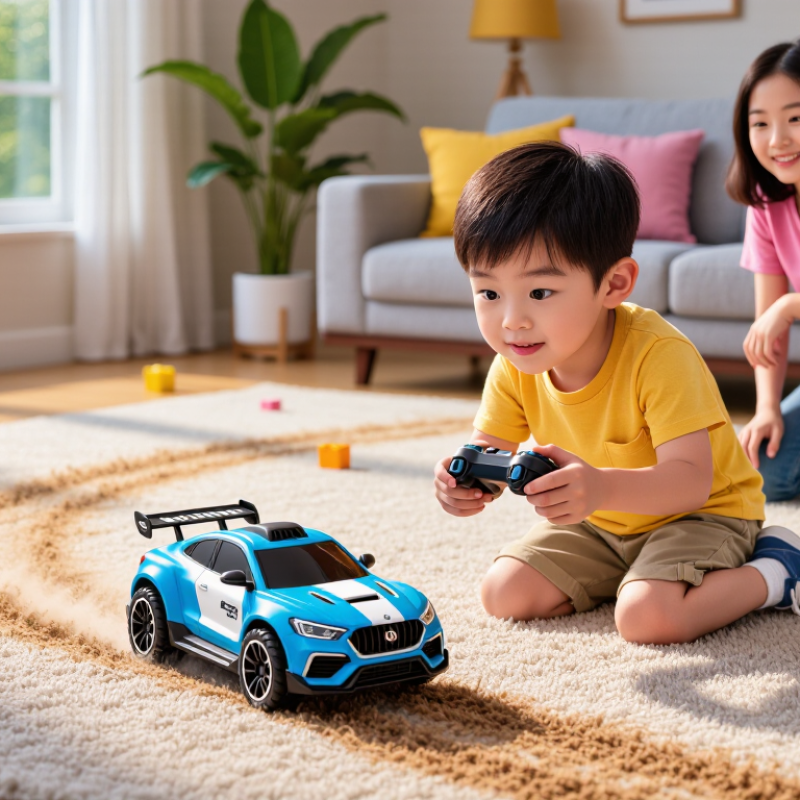
Hand-eye coordination develops when children match what they see with precise movements. A remote-control vehicle makes that link visible: the car turns, pauses, or drifts as a child adjusts the controls. On a rug, a child may steer around a cushion, then reverse after a wheel catches the edge. Small corrections matter. These moments invite children to watch, predict, and respond, rather than move their hands without a clear visual goal. Short courses with soft obstacles can encourage gradual practice. But a fast vehicle or crowded space may frustrate younger drivers, so an adult can slow the activity and keep the route simple.
The World Health Organization’s 2020 physical activity guidelines recommend that children aged 5–17 average at least 60 minutes of moderate-to-vigorous activity each day across the week. Remote-control play alone will not meet that target, and the WHO guidance does not measure coordination gains from toy vehicles. It is better viewed as one small practice opportunity alongside outdoor movement, drawing, and ball games. A child might walk after the vehicle, crouch to retrieve it, then try the turn again. Not every attempt works. That is useful, too: children can notice what went wrong and change one movement at a time.
| RC Vehicle Activity | Coordination Skill Practiced | How the Activity Works | Observable Practice Goal |
|---|---|---|---|
| Steering through a wide turn | Visual tracking and directional control | The child watches the vehicle’s position and adjusts the steering control to guide it around a curve. | Follow a clear path and make gradual steering corrections. |
| Driving around cones or soft markers | Hand-eye coordination and spatial awareness | The child uses visual information about the vehicle and nearby markers to choose when and how much to steer. | Navigate a simple course while avoiding obstacles. |
| Starting, stopping, and changing speed | Timing and control of hand movements | The child watches how the vehicle responds to the speed control and adjusts its movement to suit the available space. | Use controlled starts and stops rather than continuous, unplanned movement. |
| Driving in reverse | Visual interpretation and motor adjustment | Reversing changes the relationship between the control input and the vehicle’s direction, so the child must watch closely and make corrections. | Move slowly and make small adjustments while reversing. |
| Parking inside a marked space | Judging distance and precise steering | The child compares the vehicle’s position with the boundaries of a marked area and adjusts its direction and speed. | Bring the vehicle to a stop within a generous, clearly marked space. |
| Following a moving target at a safe distance | Tracking and responsive control | The child observes a slowly moving target and adjusts the controls to keep the vehicle moving in the same general direction. | Maintain a steady pace without crowding or bumping the target. |
Note: These activities provide opportunities to practice visual tracking and coordinated hand movements; they do not guarantee a particular developmental outcome. Choose a vehicle and play area suitable for the child, keep play away from roads and other hazards, and supervise as appropriate.
Children judge distance, direction, and speed while steering. A gap between chair legs makes these judgments concrete.
They can adjust the throttle or approach angle and test another idea. Sometimes they still miss.
Ask, “What could you change?” Then wait a few seconds before offering help. The pause may feel awkward, but it gives children room to think.
Place cushions or paper markers on a smooth floor. These create small obstacles without making play feel like a test.
One child can drive while another spots obstacles and suggests a route. Then they can switch roles.
Let them try to solve small disagreements before stepping in. A few crashes are normal.
No. Shared play can create chances to listen, explain, and cooperate, but one toy cannot guarantee a particular result.
Let them watch before inviting them to join. Pushing too quickly may not help.
Remote control vehicles offer children more than entertainment. As they steer, accelerate, and navigate around obstacles, they practise coordinating what they see with how their hands respond. Guiding a vehicle through different routes also helps them judge distance, understand direction, and think through simple problems, such as how to get around a barrier or reach a target.
So, what are the benefits of remote control vehicles for children? Shared play can encourage children to communicate, take turns, and cooperate as they plan routes or create friendly challenges. Taking a vehicle outdoors can inspire active exploration and give children a reason to notice their surroundings. Choosing an age-appropriate vehicle and playing in a suitable, supervised space helps keep the experience safe while supporting confidence, coordination, and growing skills.

